
written by JOHN MARK MINES | VALUE, FEAR, RELATIONSHIPS
When people are treated as things,
Paulo Freire
they become things.
Silicone Parts Were Made for Toys
A long time ago in a galaxy far, far away, Buzz Lightyear was our only hope. Only he could stop the evil Emperor from “building a weapon with the destructive capacity to annihilate an entire planet.” He’s one rendezvous with Star Command away from saving the galaxy.
Or not. One cowboy Sheriff doesn’t believe him. “You are a toy!” Woody yells loud enough Buzz can hear through his retractable helmet. “You’re an action figure. You are a child’s plaything!”
In Pixar’s 1995 film Toy Story, Buzz realizes the truth about his identity. He’s not the galaxy’s last hope. He’s not even a Space Ranger. He’s not a person; he’s a product.
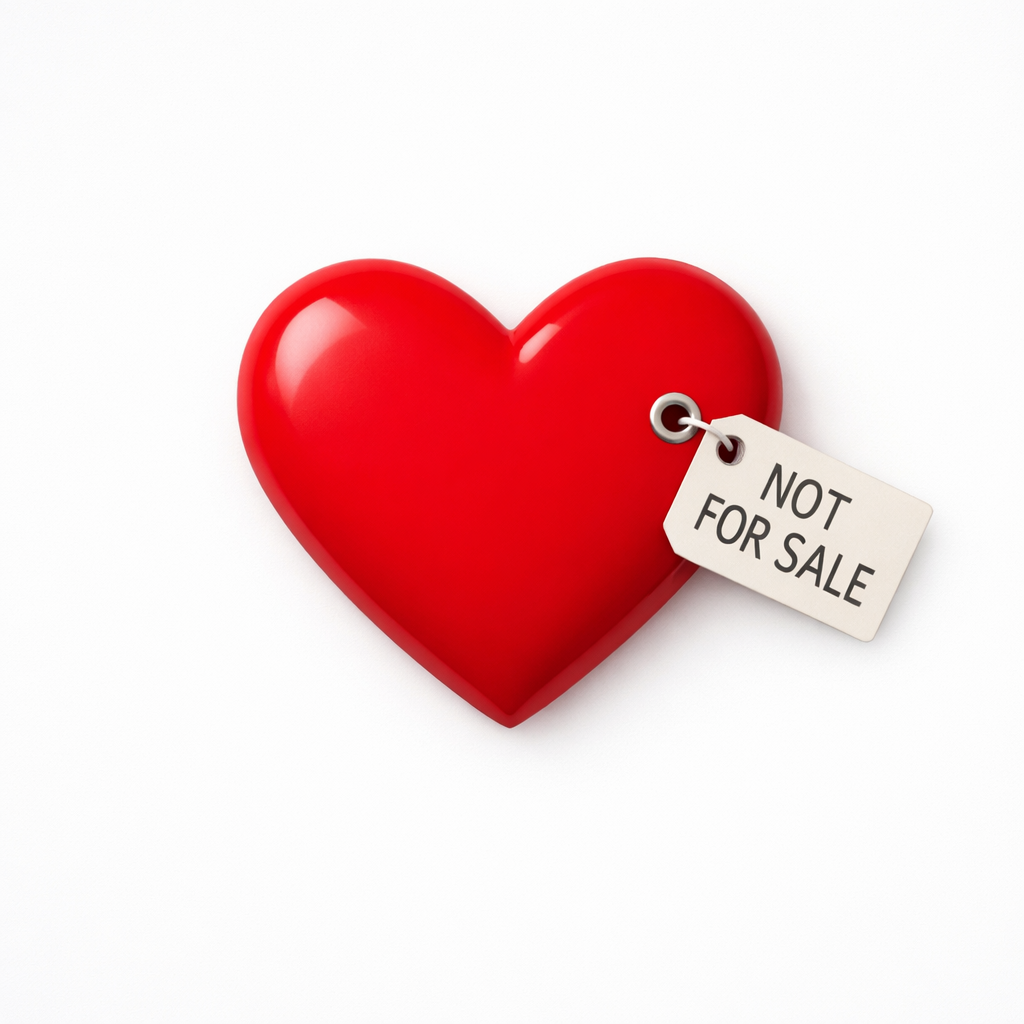
Perhaps this Valentine’s Day is a good opportunity to ask yourself the same question: are you a person or a product?
Howdy Partner
In high school psychology class, my teacher compared romance to rank. To prove his point, he conducted a social comparison experiment. A number was placed on the back of each student for all to see. The goal was simple: partner up with the highest value possible.
Here’s the trick. Each student didn’t know their own number. We had to gauge our value based on the reactions of others. Through these implicit interactions we could infer our standing. And we did.
To cold-hearted academics and elitist matchmakers, romance is about ascending an invisible ladder. When a better offer arrives, is it acceptable to level up just like Scarlett O’Hara in Gone with the Wind?
In this view, people are like products. The iPhone 17 trumps the 16; the house supplants the apartment. People carry invisible tallies the way products carry price tags, and we purchase the nicest we can afford.
We love comparisons, from who got picked for the Super Bowl halftime show to who didn’t get picked for the Hall of Fame. Evolution and economics demand excellence in the areas of comparison and competition. In the high school experiment, we excelled at finding a match in quantitative proximity. All except one.
One pair was numerically lopsided. Somehow, a high and a low bucked the trend. The teacher was confused, until he realized the pair was actually a couple. Love changed the equation.
Safety In Numbers
In the film Good Will Hunting, Will struggles with abandonment. After being physically abused in foster care, he keeps the world at arms’ length. In his mind, people are reduced to puppets and puzzles. If people are playthings, they can’t hurt him. But they can’t love him, either.
Products are safe. They offer us total control. They offer diversification and novelty. If they refuse or complain, they get replaced. In the words of Eazy-E, if something breaks, “I’ll throw it in the gutter, and go buy another.”
Surrounding yourself with a few of your favorite things architects a world of freedom, safety, and control. We’re in a world of our own imagination. We’re like Andy playing in his room in Toy Story. The toys freeze instantly when he enters the room. He is the center of the universe, but he is also alone.
Andy plays with toys because he is a child. Will plays with people because he is afraid of getting hurt. This social distancing is a double-edged sword: what prevents him from hurt also prevents him from happiness. That’s like never eating again from fear of food poisoning. Eventually, the deprivation is worse than the poison.
People, Please
When Will meets Skylar, she falls in love. He doesn’t. He’s stuck seeing people as products, as numbers in an equation. Will is good with numbers; they are his safe place. With his talent, he could use numbers to change the world. But he can’t use them to change himself.
The power of relationship cannot be overstated. The longest study ever conducted on human happiness is so long it’s still going. Nevertheless, the conclusion based on 85 years of data has long been obvious: “Good relationships keep us happier and healthier. Period.”1
What makes a good relationship? From the data, one common denominator emerges. A good relationship is with someone you can count on.
These relationships treat you like a person. They come in the clutch when it’s inconvenient. They serve, sacrifice, and support. It’s not a business decision; it’s a human one.
When people are treated like products, good relationships disintegrate. We are all just one bad day away from getting ghosted or thrown in the gutter. In this world, words like trust and commitment capture the power of the law, not the power of love. Interactions are reduced to transactions.
As frustrating as people may be, we’re miserable without them. In the end, products are cheap and replaceable. Good relationships are rare and personal. They enable experiences like acceptance, love, and forgiveness. These are the things that make us happy. They can’t be quantified, and they certainly can’t be bought.
So this Valentine’s Day, if you’re looking for love, do yourself a favor: find a person, not a product.
